Why this happens
This tends to happen for two reasons:
- Not fully understanding what the Discussion is supposed to do
- Being afraid of saying something potentially stupid or wrong
What the Discussion is supposed to do
The purpose of the Discussion is to contribute knowledge, by arguing why your interpretation of the research is the best current possible interpretation (see also What is a paper for a brief background).
Generalising means writing something that could be wrong
If you’re writing a paper based on empirical research, you’re most likely expected to generalise your findings. You found something about one or two sites, populations, or samples — now you have to say what that means more broadly. This can be scary, because there’s inherent uncertainty in doing so.
This is also, likely, the second reason the Discussion feels intimidating. Up to this point, your work has probably involved solving a problem, gathering data, or validating a method — tasks with a right answer you can check yourself on. Generalising is different: you’re writing a claim that could turn out to be wrong, and there’s no way to fully check it yourself before submitting it. Not every study trains you for that shift, so if it feels uncomfortable, that discomfort makes sense — you’re not doing something wrong, you’re doing something new.
Practically, this means articulating what your study concludes, not just what it did. Ask yourself: if this finding holds true beyond the specific constraints of your study, how does it answer your research question?
Not every field builds knowledge this way
Ecology, my own field, leans heavily on this kind of generalising, and other fields may not require it to the same degree. It depends on the type of knowledge you’re contributing )see What is a paper). For example, engineering papers that ask the question ‘can we build this’ or descriptive papers that ask the question ‘what is x’, don’t require this type of generalising,
Abstraction is how you generalise
So how do you actually do this? One useful tool is abstraction: restating a concept in more general terms.
The abstraction ladder¹ is a good illustration. At the bottom sits something fully concrete — the cow Bessie. Moving up the ladder, Bessie becomes the more general terms cow, then livestock, then wealth.
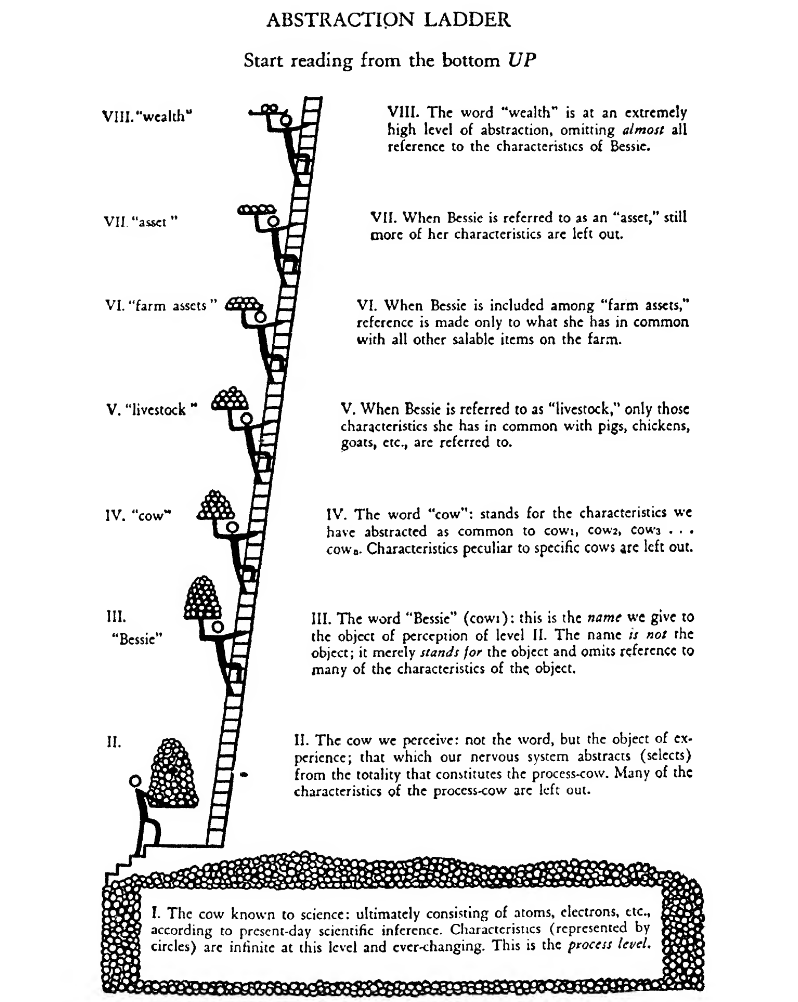
The same move works for your results. Take a highly specific finding:
We found that juvenile Atlantic salmon exposed to 20 µg/L of nitrate had a 12% reduction in growth rate over 8 weeks.
Climb the ladder, and it becomes:
Nutrient pollution can impair fish growth during early developmental stages.
Notice that the second sentence isn’t a rephrasing of the first — it’s a bigger claim. The salmon sentence is fully backed by your data alone. The nutrient-pollution sentence reaches beyond your data, so it needs more to support it: literature showing similar effects in other species or contexts, or sound reasoning for why your mechanism should generalise. That’s normal, and fine — as long as the reasoning is logical and the evidence is real. It’s just no longer free. The higher you climb the ladder, the more you owe the reader in support for standing there.
Avoiding repeating the Results
So, how do you avoid repeating the Results? By moving up one, two, or three rungs on the abstraction ladder — restating your finding in more general terms — and then finding evidence that supports those more general claims.
This is why a good Discussion doesn’t just say the same thing as your Results in different words. It says something more than your Results — a claim your data alone doesn’t fully prove, but that your data, combined with outside evidence or sound reasoning, can support. That extra layer is the actual contribution: not “here’s what we found” again, but “here’s what it means.”
Practically, this gives you a simple check for any Discussion paragraph that feels repetitive: if it only restates your finding, you haven’t climbed the ladder yet. Climb one rung, then go find the literature or reasoning to defend standing there.