Writing is more like doing a logic puzzle than following a recipe. You learn something about your findings, which reshapes the question you posed, which in turn changes how you must present the findings (x).
The phases kind of ping-pong back and forth until everything aligns. In practical terms, you’ll often find that you need to tighten the Introduction after working on the Discussion.
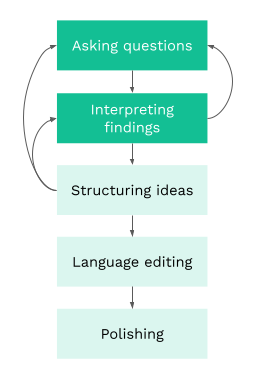
Dependencies in the writing process
Developing the subsections of your paper You can start in any order you like. When you get stuck, you might have stumbled on a dependency.
| Subsection | Content | Structure |
|---|---|---|
| Abstract | Summarise after the paper is complete | |
| Introduction | ||
| - Broader context | Capturing research decisions | Introduction logic |
| - Current state of knowledge & gaps | Capturing research decisions | Introduction logic |
| - Study aims & scope | Capturing research decisions | Introduction logic |
| Methods | ||
| - Rationale | Capturing research decisions | |
| - Procedure | Capturing research decisions | |
| Results | ||
| - Supporting & Main findings | Interpreting data | |
| Discussion | ||
| - Summary | Summarise after the paper is complete | |
| - Main Discussion | Interpreting the findings | Discussion arguments |
| - Implications | Address the problem stated in the broader context |
- develop the content (knowledge building)
- structure the information (build an outline/reverse outlining)