Remember that examiners are looking for mastery of research skills. Which means you must be more elaborate in your explanations than in a journal article:
Expand the “Current state of knowledge” section into a full Literature Review chapter (demonstrating mastery, not just finding gaps).
Be more elaborate about your methods choices
Lower the novelty pressure. You must show you can conduct independent research, not necessarily solve a global debate or fill a major field gap.
Even the strongest research can feel arbitrary if your reasoning isn’t clear. It may seem weak, even when it isn’t. The consequence: reviewers and co-authors start asking seemingly random questions, suggest moving information to the supplement, or request additional experiments. You might start to wonder if your study is flawed — it’s not. The logic just isn’t obvious enough.
Here’s why that happens. Throughout your research process, you (or your supervisor) make many decisions. In Stage 1, we captured the major ones: Significance, Knowledge Gap, Study Aims, Scope, and Methods Rationale.… Read more “Stage 2: Building the Foundation”
In ‘Building Airtight Logic‘ I explained what a journal article does: it tells a ‘story’ of why this research was conducted.
When you read a scientific journal article, it appears as if that story happened linearly — as if each decision about how to carry out the research was made in logical progression. That’s probably not true. Research is inherently messy. We try, we fail, we try again, and our understanding evolves as we go. Very little of this happens in a neat sequence.
A journal article is a story you tell about your research. Not a story in the classic sense, but in the sense that it goes beyond simply presenting data. You take your reader on a journey.
That journey isn’t just: I did this, and I did that. No, your reader wants to know why you went left here instead of right. To speak in metaphors: Why did you go to the beach instead of the mountains? Why did you take the train instead of the plane?
Freewriting is writing anything that comes to mind; basically capturing your stream of consciousness.
Why is this useful?
It’s a great technique for warming up your ‘writing muscles’, and can be helpful to overcome writer’s block. Freewriting is also useful for brainstorming, such as when trying to understand the outcomes of your research.
Try out this freewriting exercise:
Take a piece of paper and your favourite pen (freewriting works best with physical pen and paper, but a computer screen can also work).
Set a timer for 5 minutes and write.
Don’t stop writing. Don’t go back to correct something.
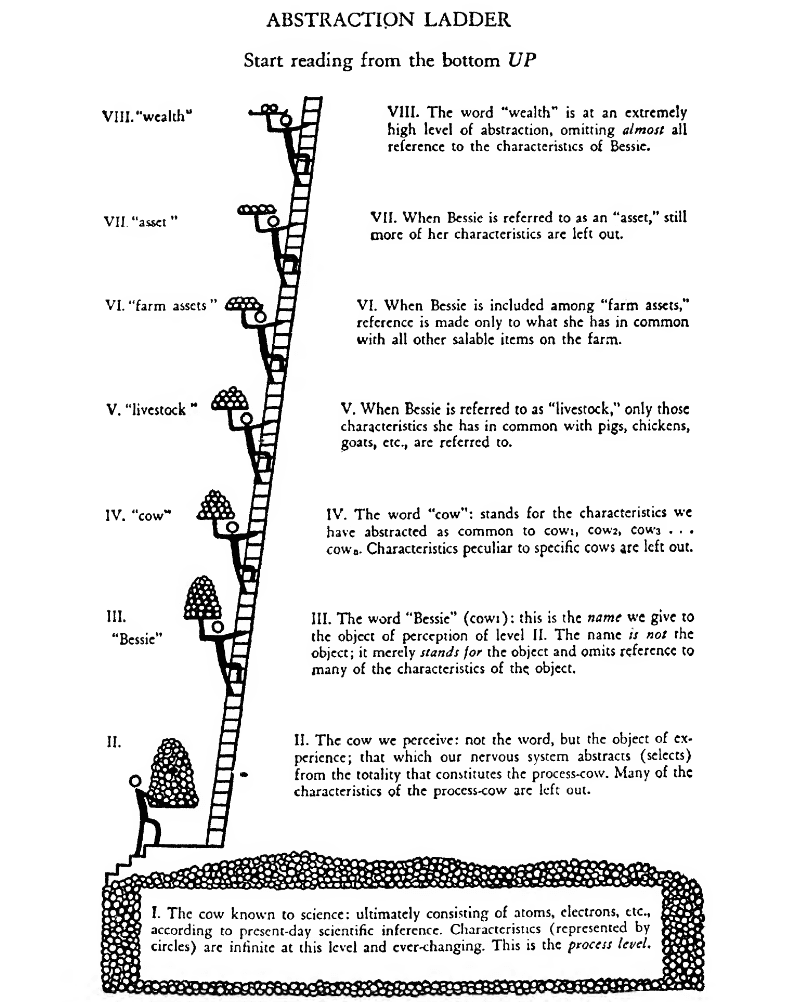
Generalising, or abstracting, is restating a concept in more abstract (general) terms. For example, if you move up along the abstraction ladder1 below, the cow Bessie becomes the more abstract terms cow, livestock, and ultimately wealth. If you move down, the term wealth becomes increasingly more specific (hence, specifying).
Why is this useful?
Generalising and specifying help with critical thinking2 and Introduction and Discussion writing. Think of it as zooming in (specifying; which happens in the Introduction, and zooming out (generalising; which happens in the Discussion). For example, generalising allows you to rewrite the results of your study — which are often highly specific — in more general terms:
We found that juvenile Atlantic salmon exposed to 20 µg/L of nitrate had a 12% reduction in growth rate over 8 weeks.
Welcome to the 10000WORDS Scientific Writing Knowledge Hub. Here, you can find information curated by me on how to write scientific research articles and theses. You can search for information by specific writing techniques, formatting guides, look up productivity advice, or jump straight to the section on comprehensive writing guides.
I used to write and write, only to end up with pages of garbage. Or I’d get stuck trying to make every sentence perfect — and produce almost nothing. Turns out, I wasn’t drafting. I was just overthinking. Once I learned what drafting actually means everything changed. Here’s the simple system that helped me write faster and think clearer.