
Part 1: IMRaD Sections
Part 2: How long should each section be?
Part 3: How to align your structure across sections
Part 4: The hidden structure behind IMRaD
Using this template for your MSc thesis?
Remember that examiners are looking for mastery of research skills. Which means you must be more elaborate in your explanations than in a journal article:
- Expand the “Current state of knowledge” section into a full Literature Review chapter (demonstrating mastery, not just finding gaps).
- Be more elaborate about your methods choices
- Lower the novelty pressure. You must show you can conduct independent research, not necessarily solve a global debate or fill a major field gap.
IMRaD Sections
- Introduction
- Broader context
- Current state of knowledge & knowledge gaps (–> Literature Review in MSc Thesis)
- Study aims and scope
- Literature Review (MSc Thesis)
- Methods
- Rationale
- Main methods
- Results
- Basic results
- Main results
- Discussion
- Summary
- Main discussion
- Implications
Introduction
The introduction helps your reader decide if the paper is interesting for them. It guides the reader from broad context to specific research aims.
Broader context
This subsection argues why this research topic is so important to study – and also why this paper is important for your audience to read. The broad context usually starts with a fundamental why – understanding this topic is critical for saving lives, animals, money, etc. After this, you briefly explain the current state of the art as well as the limits of current approaches. You finish this section concluding that more research is needed on xyz.
Example sentences:
- Fundamental why: Understanding … is critical for ….
- Current state of the art: Existing approaches have enabled …, but they remain limited in ….
- Broad issue: Hence, a critical next step is to determine ….
Current state of knowledge & gaps
This subsection reviews the literature on what is currently known – and not known – about the broad issue. It should not be a complete literature review, but a succinct summary that identifies the knowledge gap (which justifies the research questions). Once the knowledge gap has been identified, you can conclude that more research is needed to address this gap.
Example sentences:
- Opening the review: A growing body of evidence indicates that ….
- Stating the knowledge gap: While previous research has clarified …, it has largely overlooked …
- Justifying the research: This highlights the need for focused investigation into ….
→ Note: There are various types of knowledge gaps, such as:
- Conceptual: unclear or incomplete understanding of ideas
- Empirical: lack of data or evidence
- Methodological: limited or inappropriate research methods
- Contextual: missing research in certain settings or situations
- Practical/applied: knowledge not translated into practice or solutions
- Theoretical: inconsistencies or weaknesses in theories
- Population/demographic: understudied groups or samples
- Evidence synthesis: absence of systematic reviews or meta-analyses
Study aims & scope
This subsection tells the reader exactly what they can expect from your paper. It opens with the study aims (here’s what we’re going to study), sometimes followed by explicitly stated research questions. However, the study aims can also implicitly stated the research questions (e.g. ‘We aim to identify how x affects y.’ If you have specific hypotheses, you can mention them here as well.
If needed, you can also include the study scope (boundaries of the study), so that the reader knows what is (or is not) included in this journal article. Common boundaries are study location or population. Often, the paragraph finishes up with a concluding sentence that states the study outcomes.
Example sentences:
- Study aims: In this study, we investigate ….
- Research questions: To achieve this, we study …, …, and ….
- Hypotheses: Based on …, we expect to find that ….
- Study scope: The study considers … but does not examine ….
- Contribution: This work contributes to … by offering
Methods
In the Methods, you explain to the reader how the research questions were answered, what specific variables you used, and how you obtained the data.
Rationale
The methods rationale explains the choices made in designing the study – e.g. what variables, populations, locations, species, patient groups, time periods, or systems were selected and why (e.g., “To study X, we selected X_subset because…”). If the methodology or model choice is not obvious, you can also explain that here.
This subsection also serves as a brief overview for the reader. It tells them what was measured (or e.g. which model was used), before it dives into the detail of exactly how these measurements were obtained. In some journals, this rationale is not an separate paragraph, but rather woven into the text (e.g. Nature).
Example sentences:
- Remind reader of study aims: In this study, we aimed to …
- Briefly explain how you achieve those aims: To achieve this, we selected the following variables: …
- Why you made these decisions: Our selection was guided by ….
The main methods
This part of the paper explains the reader how the measurements were obtained, explaining for each dataset how the experiment was designed (which study groups did you have, how many samples did you take, how frequently, etc.), how the data were collected (experimental setup, how were data collected, how were samples prepared, what instruments or materials were used, what is the source of existing data, etc.) and how the data were analysed – including data transformations and statistical analyses.
Example sentences:
- Experimental design: We selected … groups to study: …
- Data collection: Data were collected using ….
- Data analysis: Statistical analyses were conducted to evaluate …
Results
The Results section presents your findings using figures, tables, and other information.
Basic results
The Results will often start with the basic results first. These don’t answer a research question directly, but validate the more complex results that follow in the main results section.
Examples of basic results are sample characteristics, descriptive statistics for key variables (mean, median, standard deviations), or environmental conditions (temperature, pH). Sometimes, these basic results are included in the Methods section (check journal articles in your field to see what is common practice).
Example sentences:
- Describe data: The … followed general patterns across groups (fig. 1)
The main results
In the main results, each paragraph should roughly address one research question. The paragraph starts with a general statement that summarises the main findings, followed by detailed results that support this general statement. These detailed results should be mentioned in order of complexity, starting with basic or raw data and progressing to more processed or complex analyses.
Example sentences:
- General statement: Overall, the data show that ….
- Specifics: Specifically, we found that ….
- Specifics: However, in group A …
Discussion
In the Discussion, you’re going to present the reader with your interpretation of the data and explain what your data mean for the bigger picture.
Summary
Often, but not always, the Discussion will start with a short summary that hooks the reader – and reminds them what you did (most readers skip the Methods and Results anyway). Here, you can restate the research aims, state the most interesting findings or conclusions, and briefly describe the contribution of the study.
Example sentences:
- Restating the research aims: This study set out to investigate ….
- Main findings or conclusions: We found compelling evidence that ….
- Study contribution: Our work offers a novel approach to ….
Main discussion
In the main part of the Discussion you argue how your findings change the current understanding of the system, by addressing each research question.
Start by stating the (main) results you’re going to discuss, and then reference supporting literature that found similar results. Then, draw a conclusion based on this information that answers the research question. Next, address any conflicting evidence (findings, literature, or study assumptions) that do not support the conclusion, and provide a rebuttal explaining why the conclusion is still valid. If this is not possible, acknowledge this as a study limitations, and suggest how future research can address this.
The order can be flexible – for example, you could also start with the conclusion – so long as the reasoning is clear.
Example sentences:
- Main finding: Our results showed that ….
- Supporting evidence: A similar pattern has been identified in … (Ref et al., 2005).
- Conclusion: Together, these findings suggest that …
- Conflicting evidence: However, a study on … showed that …
- Rebuttal: Nevertheless, our explanation remains more likely, because ….
- Study limitations: We were not able to address …, because … .
- Future research directions: Further research on … could address ….
Implications
The implications circle back to the broader context and issue introduced in the first paragraph of the Introduction. White this broader issue is too general to address in its entirety, you should explain how your study contributes to it.
The Implications section is sometimes labeled “Conclusions and Implications,” “Concluding Remarks,” “Outlook,” or simply “Conclusions,” depending on the journal and the specifics of your research. Regardless of the name, its purpose is the same: to link your study back to the broader context, highlight the study contributions, and suggest future directions or potential applications.
Example sentences:
- Restating study outcomes (main findings or conclusions): In summary, this study provides compelling evidence that…
- Future research directions: Future work could build on this foundation by…
- Impact on theory, practice, or policy: The presented evidence should inform …
How long should each section be?
| Section | Journal Article (paragraphs) | MSc Thesis (~15,000 words) |
|---|---|---|
| Introduction | ||
| Broader context | ~1 paragraph | 2–3 paragraphs (~400–600 words) |
| Current state of knowledge | 1–3 paragraphs | – |
| Study aims & scope | ~1 paragraph | 2–3 paragraphs (~400–600 words) |
| Literature Review | – | 6–9 paragraphs (~1,200–1,800 words) |
| Methods | ||
| Rationale | ~1 paragraph | 3–4 paragraphs (~600–800 words) |
| Main methods | Variable | 6–10 paragraphs (~1,200–2,000 words) |
| Results | ||
| Basic results | ~1 paragraph | 3–4 paragraphs (~600–800 words) |
| Main results | Variable | 12–18 paragraphs (~2,400–3,600 words) |
| Discussion | ||
| Summary | ~1 paragraph | 3–4 paragraphs (~500–800 words) |
| Main discussion | Variable | 8–12 paragraphs (~1,600–2,400 words) |
| Implications | ~1 paragraph | 3–4 paragraphs (~500–800 words) |
Notes:
– Thesis lengths vary by field and university regulations — check your handbook.
– A paragraph equals roughly 200-250 words.
– Max. words count varies per publication (generally 5000 words), check the author instructions of your intended journal.
If you write dense, technical prose with many short data paragraphs, adjust downward; if you write discursive, explanatory prose, adjust upward. Check your faculty guidelines—some specify word counts per chapter.
How to align your structure across sections
Introduce and discuss your research questions consistently, using the same order across the Introduction, Methods, Results, and Discussion. This makes the paper easier to follow and lets readers quickly map questions to findings and interpretation. The Discussion typically sets the order, with the other sections following it.
There are two common approaches:
- From most to least exciting: Present the research questions in the order of the most interesting or impactful findings and conclusions first.
- Sequential/stepwise: If the questions build on one another, start with the simpler or more basic questions, then show how later analyses build on them.
It’s sometimes possible to mix these two approaches. In that case, lead with the most exciting stuff first. If you’re not sure how to go about this, ask your supervisor(s) for ideas – they can help you decide the order that best highlights your results and narrative.
If your MSc thesis contains two or three related experiments (e.g., a pilot + main study, or sequential phases), it sometimes recommended to use a nested structure:
- Introduction for the whole thesis
- Introduction per experiment
- Methods per experiment
- Results per experiment
- Discussion per experiment
- Synthesis: Discussion for the whole thesis
The hourglass applies twice: Once at the thesis level (broad problem → specific experiments → broad implications) and once within each experiment chapter. Think of it as Russian dolls: each study is a small IMRAD inside the big thesis IMRAD.
The hidden structure behind IMRaD
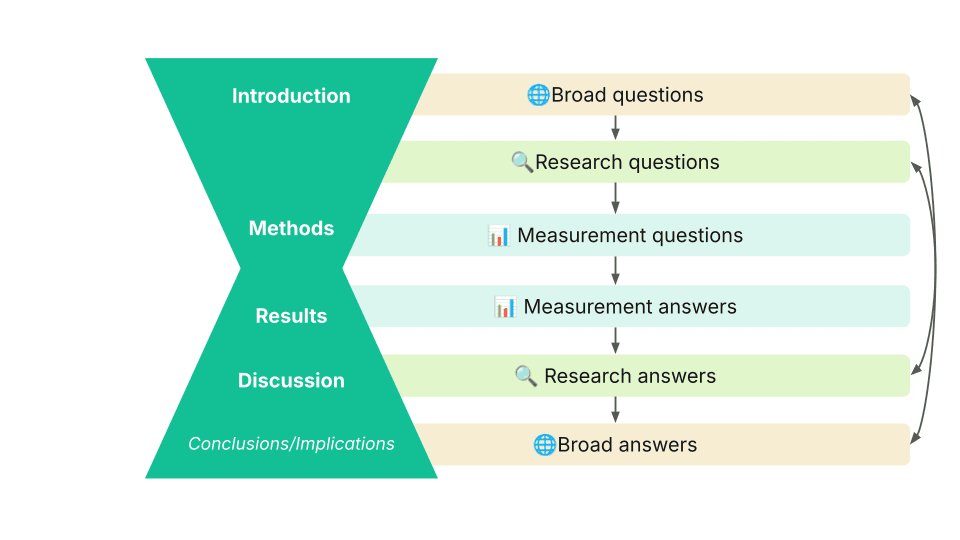
Scientific papers often feel difficult to write — not because the IMRaD format (Introduction, Methods, Results, and Discussion) is complicated, but because the logic behind it is hidden. Once you understand the questions that drive each section, the structure becomes much easier to work with.
At the heart of a paper are three levels of questions:
🌐 Broad, general question(s)
- Concerned with broad, often societal issues; usually one question, found2 at the start of the intro.
- Asks stuff like: How can we improve this (complex) process/situation/…?
- Is so broad that it can’t be fully answered in the paper (research will address a small subsection of the broad question), but will often be partially addressed in the Implications or Conclusions section.
🔍 Research questions
- This is the stuff you actually wanted to study. Will ask things like: How does x affect y? To what extent does a cause b?
- Usually (implicitly) asked2 in the middle/final part of the Introduction.
- The research questions are extensively addressed in the Discussion, using the results and literature.
📏 Specific, measurable questions
- Highly specific, measurable questions that focus on the actual (often quantitative) variables. Will ask things like: To what extent does x_study affect y_subset, given a?
- These questions are implicitly stated2 in the Methods and can be considered subquestions of the research questions.
- Answered in the Results section using the data.
Zooming in and out
These layers of questions create a hidden structure that mirrors the famous hourglass shape of IMRaD:
- Zoom in: from broad, general questions (Introduction) → to focused research questions (Introduction/Discussion) → to specific, measurable questions (Methods/Results).
- Zoom out: from specific answers (Results) → back to broader implications (Discussion/Conclusion).
Once you see this structure, IMRaD stops being a rigid template and becomes a logical flow of questions and answers. That’s the hidden scaffolding that makes papers coherent — and much easier to write.
Thesis vs. Article
If you are writing an MSc thesis, understanding this structure helps, but you will not be penalized if your sections stand solidly side-by-side rather than weaving together. Examiners assess competent rooms, not flowing architecture.
If you are writing a journal article, this narrative weaving is essential—reviewers reject papers that list findings without demonstrating how they change the field. Master this in Building Airtight Logic →.